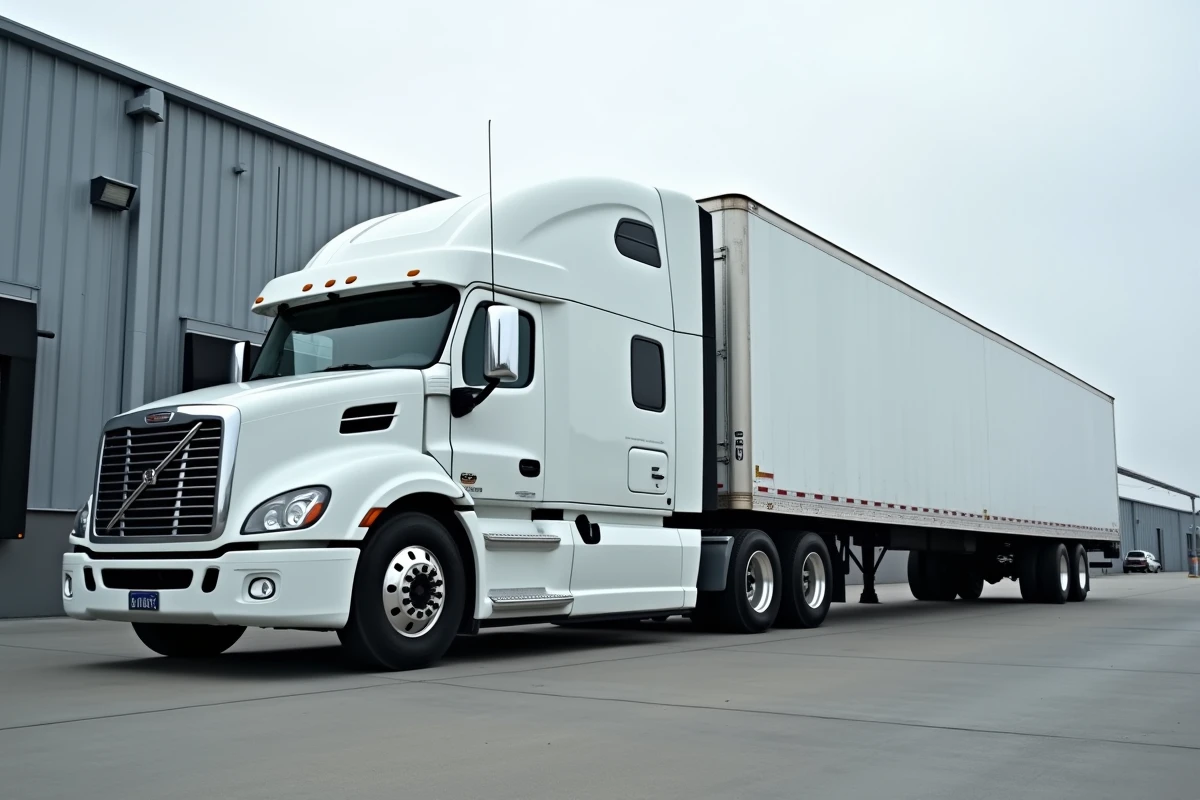
A semi-trailer truck refers to the road vehicle consisting of a tractor and an articulated trailer, connected by a coupling device. In Europe, the maximum allowed dimensions for this combination are set by community directives, while North American regulations operate by federal state. Understanding these dimensions helps anticipate loading, traffic, and compliance constraints.
Regulatory dimensions in Europe: maximum length, width, and height
In France and most European countries, a tractor plus semi-trailer combination does not exceed 16.50 m in total length. The standard width is limited to 2.55 m. Refrigerated trailers, which have thicker insulating walls, benefit from a tolerance increased to 2.60 m.
The maximum allowed height reaches 4.00 m. This ceiling directly conditions the usable interior volume, especially for the transport of palletized goods in double levels.
To learn more about the dimensions of a semi-trailer truck, it is essential to distinguish between the external dimensions (overall footprint) and the internal dimensions (actually usable loading space), as the thickness of the walls, floor, and roof significantly reduces the available volume.
Level 4 autonomous semi-trailers: dimensions that challenge urban standards
The Level 4 autonomous semi-trailer prototypes tested in 2026 present a concrete problem for European cities. These vehicles maintain the regulatory dimension of 16.50 m, but their design without a traditional driver’s cabin redistributes the allocation of space.
The more compact autonomous tractor frees up length that is transferred to the trailer. The loading volume increases without exceeding the legal limit. The difficulty arises in urban maneuvers: a turning radius calibrated for a conventional tractor no longer corresponds to a shortened tractor whose coupling point is located differently.
Manoeuvrability in dense urban environments
In city centers with narrow streets, the turning radius remains the limiting factor, more so than the total length. A shorter autonomous tractor alters the kinematics of the trailer’s rear axle during tight turns. The lateral sweep of the trailer may increase, complicating passage through intersections designed for conventional articulated combinations.
Municipalities hosting these tests in 2026 must adapt their delivery routes and, at times, their road infrastructure. The maximum length standard is no longer sufficient: it is the dynamic geometry of the combination that determines compatibility with the urban network.
Differences between European and North American standards
North American standards are based on imperial units. The most common trailer lengths are 48 feet (approximately 14.63 m) and 53 feet (approximately 16.15 m). The standard width reaches 8 feet 6 inches, or about 2.59 m.
A recent development modifies this framework. The FMCSA Rule 2025-02, published in the Federal Register on January 10, 2026, allows a maximum width of 2.70 m for aerodynamic trailers without special permits in 28 U.S. states. This measure aims to improve energy efficiency through wider side fairings while slightly increasing usable volume.
Impact of this rule on transatlantic transport
For logistics operators working between Europe and North America, this 15 cm width discrepancy complicates the interoperability of containers and mobile boxes. A trailer compliant with the 2.70 m American standard does not meet the European limit of 2.55 m. This gap imposes design choices when ordering rolling stock intended for both markets.

Interior dimensions and usable volume: what matters for loading
The external dimensions do not directly reflect transport capacity. On a standard European tautliner semi-trailer, the typical internal dimensions are as follows:
- Usable floor length: approximately 13.60 m, which is the length of the trailer alone without the tractor
- Internal width: close to 2.46 m after deducting the thickness of the side walls
- Usable height under the roof: variable depending on the type of floor, but generally around 2.65 m to 2.70 m
The low-deck floor is gaining ground in refrigerated transport. According to a case study published by DHL Logistics in April 2026, this type of floor reduces loading times at European docks by 20 to 30%. The gain comes from a more precise alignment between the dock level and the trailer floor level.
Maximum authorized weight and load distribution
In France, the maximum authorized total weight (PTRA) of a standard articulated combination is 40 tons, increased to 44 tons for certain combined rail-road transports. The distribution of weight between the tractor’s axles, the coupling device, and the trailer’s axles conditions compliance as much as geometric dimensions.
- Poorly distributed loading can lead to axle overload even if the total weight remains within limits
- Onboard weighing systems, increasingly common, alert the driver in real-time about the distribution
- The height of the center of gravity, related to the internal height and type of goods, directly influences stability in turns
The choice of a semi-trailer is therefore not limited to comparing lengths and widths. The compatibility between the dimensions, usable volume, and allowable load forms a triangle of constraints that each transport operation must resolve. With the arrival of autonomous tractors and the gradual widening of aerodynamic standards, this triangle becomes more complex, pushing carriers to rethink their criteria for selecting equipment.